Wednesday, September 2, 2009

ECOTICOS en segundo Conservatorio sobre
ACOSA-Terraba Sierpe

El día 21 de Agosto de 2009, se desarrolló en las instalaciones de la Fundación Neotrópica en Rincón de Osa el segundo Conversatorio "LA PROBLEMÁTICA AMBIENTAL DEL PACÍFICO SUR, EN POS DE UNA AGENDA CONJUNTA DE PROPUESTA TÉCNICO-POLÍTICA".

En esta ocasión el conversatorio estuvo marcado por la presencia de un gran número de organizaciones del SUR-Sur del país, entre los que se encuentran asociaciones de desarrollo, organización de pescadores, oreros, agricultores y otras organizaciones interesadas en enfrentar la problemática ambiental de la zona.

El sector hotelero también se hizo presente a este evento, así como diferentes ONG`s fundaciones y por supuesto los miembros del proyecto ECOTICOS UCI-ELAP, Fundación Neotrópica y Earth Economics.

A los asistentes (36 personas de 18 organizaciones) se les presentó el mismo formato de agenda para dirigir la actividad, sin embargo los resultados si bien tienen la misma orientación de los resultados del Conversatorio en la UCI el día 31 de Julio, se encontraron expectativas a muy diferentes niveles.

Es importante resaltar la madurez de las organizaciones locales presentes los cuales discutieron temas puestos por ellos mismos en el conversatorio, referente a los nuevos modelos de desarrollo agrícola y comercial de la zona, la debilidad de la legislación, la importancia de la incidencia política para enfrentar esta problemática, el involucramiento de la juventud en iniciativas de conservación, el respeto a los derechos de los pueblos indígenas y la promoción de la cultura entre otros.

En conjunto se definieron las aspiraciones generales de los presentes algunos de las cuales aparecen a continuación.

 Apoyar sus funciones en los Planes de manejo establecidos
 Trabajar más en Gestión comunitaria
 Reforzar la gestión de los consejos locales mediante la formación y capacitación idónea para cubrir su accionar
 Socializar los planes de manejo
 Buscar canales de información y denuncia más efectivos
 Buscar un foro de concertación apoyado por las organizaciones con más experiencia en la zona
 Propiciar espacios para discutir los procesos ambientales, comunales y sociales para plantear soluciones concertadas y prácticas
 Establecer prioridades y generar recursos para iniciar el proceso de concertación
 Unificación de diferentes organizaciones

Por ultimo se llegó a definir algunos acuerdos importantes como que los presentes usaran como mecanismo de apoyo los planes de manejo de las Áreas Protegidas de ACOSA, actuar como un grupo organizado para enfrentar la problemática y realizar reuniones mensuales de seguimiento para valorar la problemática y presentar soluciones.

Para darle continuidad a este proceso se planea realizar la próxima reunión de coordinación el día 25 de Setiembre.

Thursday, August 6, 2009

ECOTICOS convoco a conversatorio para ACOSA y Terraba-Sierpe


El día 31 de Julio el equipo de ECOTICOS convoco en la Universidad para la Cooperación Internacional a un Conversatorio "LA PROBLEMÁTICA AMBIENTAL DEL PACÍFICO SUR, EN POS DE UNA AGENDA CONJUNTA DE PROPUESTA TÉCNICO-POLÍTICA".


Este espacio de conversación se da en un momento en el que gran parte del sector relacionado con el medio ambiente, siente que a pesar de el esfuerzo realizado por años, no se logra una solución definitiva a la problemática ambiental de la zona Sur y del país en general y se nota más bien un aumento considerable en la cantidad de amenazas.

A dicha actividad asistieron 25 personas de organizaciones tales como UCI, Fundación Neotropica (miembros de ECOTICOS y coordinadores de la actividad),CEDARENA, DIGECA-MINAET, ECOTEC/RARE, fundación CORCOVADO, INBIO, INISEFOR-UNA, Kioscos Ambientales de UCR, Periódico Opinión Ambiental, TNC, ASCONA entre otros.

La primera etapa del conversatorio fue enfocada en identificar puntos de Incidencia (Problemas específicos) y posterior a esto, se definió entre los asistentes la identidad y un manifiesto del Grupo:

IDENTIDAD

i. A qué aspiramos como grupo:

Ser facilitadores el proceso de elaboración de la estrategia de Desarrollo Humano Sostenible para los habitantes del Sur-Sur.

MANIFIESTO

• Reconocimiento como grupo del valor de los recursos de la zona.
• Nuestra preocupación por el deterioro de estos recursos, y de los impactos sociales, económicos, ambientales de esta situación.
• Ofrecimiento como grupo para facilitar el proceso.

Por ultimo se definieron una serie de comisiones tendientes a buscar cumplir con las aspiraciones del grupo.

Continuando este proceso se estará realizando el día 21 de Agosto en las instalaciones de la Fundación Neotrópica en Rincón de OSA otro conversatorio en este caso para organizaciones de la zona Sur.

Saturday, June 27, 2009


Notese el mensaje de mi amigo De Groot - favor ir a http://www.es-partnership.org/ e inscribrise.
Saludos,
Azur

Dear all,

I am very pleased to announce that during the Ecosystem Services modeling workshop in Lecce (26-29 May 2009) it was decided to re-launch the Ecosystem Services Partnership (ESP) with a new website (http://www.es-partnership.org/) and an expanded coordination-or support-team (see below).
As the name says, ESP is very much meant to function as a lively partnership on enhancing the science and application of ecosystem services. You can participate in different ways: help manage part of the site, organize meetings, start joint projects or publications, etc. You can also support the partnership financially or by "just" becoming a member and enjoy the benefits of this network and participate in discussion groups..

One of the Partnership activities will be to organize meetings and an important one that is scheduled already is the conference to be held in June 7-10, 2010 in Salzau castle, Germany.

For more information on this event, and other ESP-activities, and to sign-up, have a look at the website (http://www.es-partnership.org/). This site is still very much "under construction" and suggestions for improvements of the site, additional activities of the Partnership and other comments are very welcome.

Hoping you will join ESP and see you on one of the future events ! Dolf de Groot, on behalf of the other members of the coordination team and current Partners.

PS: feel free to forward this email to people whom you think will be interested

Dr. Rudolf S. de GrootAssociate ProfessorEnvironmental Systems Analysis groupWageningen UR (http://www.wur.nl/)PO Box 47, 6700 AA Wageningen

The Netherlands

Thursday, May 14, 2009

El area de estudio

Ok gente, para que todos estemos bien claros en el area de estudio de este proyecto acabo de hacer un mapita usando Google Maps. Aqui estamos:


Esta area en amarillo es una vista lateral. La idea del area es "Desde la cola de ballena hasta Drake Bay y de ahi hasta la fila costena" meternos en las areas al otro lado de la fila es camisa de once varas...


View Humedal Nacional Terraba Sierpe in a larger map

Este arriba es el mapa directo para ya ver en detalle.

Para esta fase inicial nos vamos a concentrar en las cuencas bajas del rio grande de terraba y la cuenca del sierpe. Vale?

Saludos,

ECOTICOS

Wednesday, May 6, 2009

911 Ambiental


La UCR abrio Consultorio Jurídico Ambiental Deberiamos de explorar la posibilidad de aliar fuerzas con esta gente. Ahora se pueden mandar correo al 800ambiente@gmail.com o si no llamar al 800-ambiente y denunciar atentados contra el ambiente. En buena hora.

Mas informacion aqui

ECOTICOS

Monday, April 27, 2009

WE need more students like this one


Trading rainforest for palm oil. Is it worth it?
Here's an essay from one of our students after spending some time in Sierpe. It is very encouraging to see this type of follow up. Imagine if every gringo student that came to Costa Rica followed up like this. Jesse by the way is an undergraduate student maybe this is why he's able to see past academia and think about the big picture.

Enjoy.

ECOTICOS

James M. Jeffords Center 2009-2010 Undergraduate Scholar Application
Environmental Education Without Borders
I left for Costa Rica in January 2009 to work in a little town called Sierpe, located on the mangrove ecosystem of the Osa peninsula, helping out with some community relations aspects of an environmental project of UVM’s Community Development and Applied Economics Department and the Gund Institute for Ecological Economics. During my time there Azur Moulaert (CDAE faculty and fellow at the Gund Institute) arrived for a few days with a volunteer retired pilot and two scholars from Costa Rica and Nicaragua, to do a flyover of the surrounding area, surveying the landscape, the damage that was done, and the threats that are posed. I was able to squeeze into the fifth and final seat on the tiny airplane, and the evidence I looked down upon from my birds eye view was shocking. There seemed to be a small line of trees left next to the locations in view of many people, such as surrounding towns or lining the rivers. Yet behind this thin band of trees would be a leveled landscape cleared for grazing, or miles and miles of monocropped palms. The damage that the landscape was suffering, as well as the vast amounts of biodiversity it was losing, was so apparent from overhead, yet so much harder to see from the ground. This explained why when I interviewed residents about a possible new airport in the region, they were all for it and the economic benefits more tourists would bring. It seemed that not a thought of the environmental destruction the government and developers’ airport would bring crossed their minds, and who could blame them?


There is another side to this coin, as several residents of Sierpe expressed a strong sense of pride in the natural landscape that surrounds them. The protected area of Sierpe still boasts over 50,000 acres of pristine landscape, much of the coastline remains intact, and there is still a spectacular array of beautiful wildlife. These features are the capital that the residents of Sierpe have to conserve and utilize to make their money through the attraction of ecotourism. It is understood that if these natural features of the landscape are depleted, so will the potential for generating capital in towns like Sierpe. What is not understood is just how perilous of a state this natural environment is in, and how if action is not taken now, it will soon be too late. All people – not just the locals but also the people residing in the Central Valley, the tourists visiting from abroad and the agencies that fund blanket development strategies for regional growth, environmental and social concerns notwithstanding, desperately need an environmental education/consciousness. Through my studies in Political Science, I have learned that if effective governance is ever attainable, it must be through higher levels of citizen participation, though an issue must first be understood before it is fought for.


Fortunately, we have much of the organization in place to begin carrying out an education as important as the one that is needed in Sierpe. With the help of our friends at http://www.lighthawk.org/ we took over four thousand bird’s eye photos showcasing the good, the bad, and the simply ugly affects of development on and around the Sierpe mangroves. For proof of the value of large-scale photography, look no further than Ansel Adams, who utilized the educating power of a photo to achieve environmental conservation and appreciation. If a picture is worth a thousand words, then surely the environmental awareness that our pictures can foster could be worth 50,000 acres of protected mangroves.


I propose putting these pictures and relationships to their full use by creating a bilingual exhibit to bring to the towns of Sierpe, Costa Rica, where the National Theatre of Costa Rica and the local schools of Sierpe could host, and Burlington, Vermont, where the Fire House Gallery and the Davis Center would be used. With photos blown up to 5ft by 5ft, both Vermonters and Ticos could experience the bird’s eye view while reading a story that would accompany each photo, explaining its significance, as well as the causes and consequences of the environmental degradation or threat it displays. With this kind of outreach and education, we could greatly strengthen the power and voice of this incredibly important environmental movement, integrating the passions and perspectives of both Vermonters and Ticos, a partnership that would transcend national boundaries and lend itself to a powerful education for citizens on both ends, as well as an increased influence of Ticos on the public policy that so affects them. This community exchange will be full when groups from each community visit the other’s exhibit, linking the two communities in a mutually beneficial spirit of collaboration.


By: Jesse Simmons
299 Colchester Ave Burlington, VT 05405
(617) 820 6900
UVM Majors: Ecological Economics and Political Science (Honors Program)
GPA: 3.57 (cumulative), 3.93 (most recent semester)

Wednesday, April 22, 2009

Lat/Long en Google Earth

Estimada Helena,

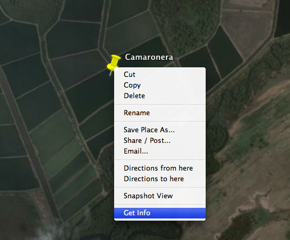
Para encontrar la latitud y longitud de un punto el Google Earth proceda asi:

Primero, identifique el punto En este caso la Camaronera.


Segundo, right click en el icono amarillo y seleccione "Get Info"


Finalmente, ahi saldra una ventana con la latitud y longitud.


Saludos,

ECOTICOS